Check out what’s
Trending

2026 Budget information
This is Home.

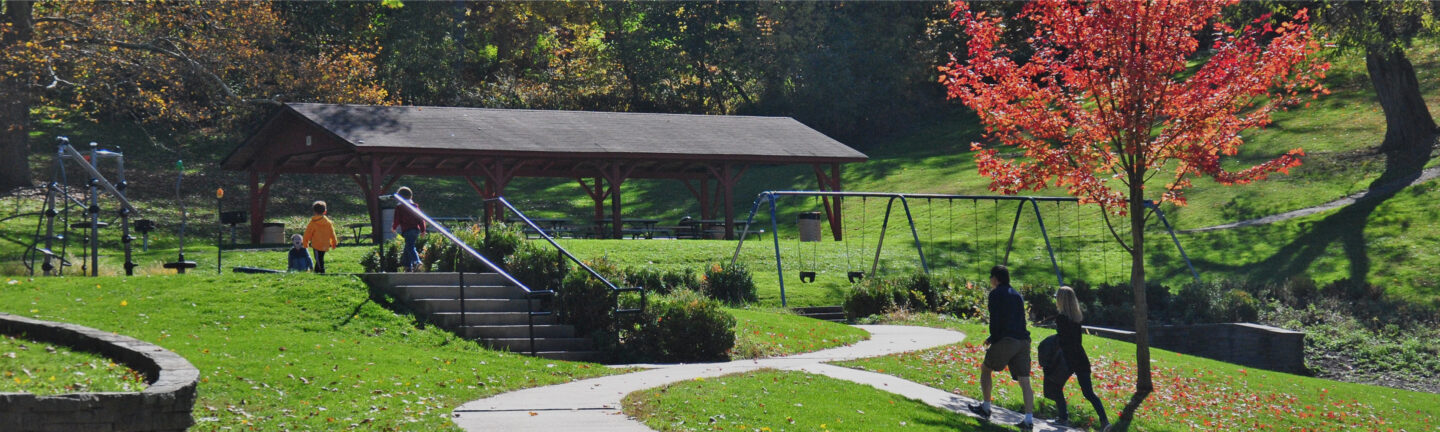
If you aren’t sure where to look for specific information on our website, please search here using keywords to learn anything from what day trash pick-up is, how to license your pet or plan a block party to how to volunteer in the community or start a business here.
These individuals have municipal areas and facilities named for them in accordance with the Mt. Lebanon naming rights policy. We honor them every day by using the facilities and recalling their special contributions. Learn about them on this page.

Marine 1st Lt. Thomas A. Bird was the first soldier from Mt. Lebanon to lose his life in Vietnam. Born November 28, 1942, Lt. Bird was raised in Mt. Lebanon. His father operated a Gulf gas station on Cochran Road. where Tom worked during high school. Interested in aviation, he used the money he earned at the service station to take flying lessons at a local airport.
Tom enlisted in the Marine Corps even before he graduated from South Hills Catholic High School (now Seton LaSalle) in April 1960. In August 1960, he left Mt. Lebanon to attend boot camp at Parris Island. A few years later he was accepted into the Marine Corps Cadet program, where he received his officer’s commission and training as a helicopter pilot and naval aviator.
A popular student in school, Tom had many friends. One, George Brown, who graduated from Mt. Lebanon High School and joined the Marines with Tom, said of him, “.. I remember the fun times we had during our high school years, [his] father’s service station, McKeen’s Dairy Store, the evenings that [Tom], Dave and I sat on the tracks above Mt. Lebanon Blvd, working out our teenage problems and joking around, Eat’n Park, double dates etc…”
Lt. Bird was a courageous war hero. His service in Vietnam was very dangerous, exposing him to hostile fire nearly every day. A younger brother, John, of Columbus, Ohio, describes one incident in Vietnam as reported in a letter home from Tom. “… he [Tom] described, with humility, how he rescued a pilot, whose helicopter had crashed into a rice paddy. He landed under enemy fire, ran to the downed chopper, lifted a radio off the man’s chest and carried him back to his aircraft.”
In March 1966 Lt. Bird was the co-pilot of a Sikorsky UH-34 based out of Chu Lai, a small village south of Da Nang. He was a member of HMM-363, Marine Air Group 36 of the 1st Marine Air Wing. This unit was occupied ferrying both US Marines and Vietnamese Army troops in operations near Quang Ngai, about 50 miles south of Danang.
On the afternoon of Monday March, 21, at around 4 p.m., Lt. Bird, age 23, and his pilot, Lt. Noah Kraft of Gainesville, Fla., were piloting a helicopter carrying six Marines from K Company 3rd Battalion 1st Marine Division with two other aircrew members in support of operation Texas, when the helicopter was struck by ground fire, crashed and burned. All 10 men aboard were killed.
Bird Park was dedicated on Memorial Day 1967. A small bronze plaque mounted on a stone there serves to honor this brave son of Mt. Lebanon who made the ultimate sacrifice in the service of his nation. May he rest in peace and may we never forget what he did.
—By Steve Lynch, Upper St.Clair resident
Named for FBI agent Martha Dixon who was killed in the line of duty, Dixon Field and Martha’s Playground are part of our Cedar Boulevard Mt. Lebanon Park complex. From her family’s nonprofit website:
Martha received her undergraduate degree in Chemistry from the University of Pittsburgh in 1982 and worked as a forensic chemist for the Arkansas State Crime Lab. She joined the FBI in 1987 and, while assigned to the Knoxville Field Office, became a technically trained agent and the first female SWAT team member for that field office. Martha was assigned to the Washington (DC) Field Office in 1992 and worked drug cases, violent crimes, and cold cases. Martha looked forward to returning to forensics and was a founding member of WFO’s Evidence Response Team, which was renamed the Dixon-Martinez Evidence Response Team in her honor.
Her family and friends channeled their grief into efforts to continue Martha’s two passions, running and children. The Martha Fund was formed in 1995 to raise funding for playground projects in her hometown. The Martha Fund’s main fundraising effort is Martha’s Run, a challenging 10K run and 2K run and walk through the rolling hills of Mt. Lebanon. Since the first fundraiser in 1995, The Martha Fund has gifted many smaller grants to assist playground projects, and in 2007, the signature project, Martha’s Playground, was unveiled in Mt. Lebanon Park. The Fund continues to support playground projects in the Pittsburgh area.
The John Doctor Field at Bird Park memorializes John Doctor, who died at age 49 of heart disease. The field was dedicated September 6, 2007.
John Doctor, PhD. died unexpectedly on October 25, 2005. John was an exceptional man who helped make the community of Mt. Lebanon a better place for young and old alike. John Doctor coached for and served on the Mt. Lebanon Soccer Association Board, assisted in organizing the Earth Day Cleanup and the Bio Blitz of Bird Park, and served as chaperone for the Mt. Lebanon High School Fine Arts Department. John was President of the Mt. Lebanon Extended Day Program, a biology professor at Duquesne University, a board member on the Mt. Lebanon Parks Advisory Board, and was a member of the Mt. Lebanon Nature Conservancy. John was a kind, happy man who gave more than his fair share to this community. He volunteered anywhere assistance was needed, always striving to make the community a better place. He is honored by this memorial for all of his achievements, successes and all the smiles he brought to the community. We hope by honoring Dr. Doctor’s memory as an outstanding volunteer, we might inspire others to follow in John’s footsteps and give of themselves to the community
Named for the Gavetts in February, 2009.
After the paddle courts were first built, there was a need for a paddle hut where players could get out of the cold while waiting for matches to begin or end. The paddle community decided to generate money by holding a series for parties and fund raisers. The Gavetts were among the first to sponsor parties to generate donations. Thus, they got the ball rolling for the first paddle hut.
As the years went by, all sorts of maintenance was required on the hut and the courts. Most of the maintenance was done by the paddle players themselves. Bob and Barb Gavett were always the organizers of the paddle crews.
The inside and outside of the paddle hut needed to be painted and stained. Bob bought the paint and stain. Bob recruited some of us to help with the painting. Bob brought the ladders and brushes. Bob brought the tarps. Bob did half the painting and made sure everything was done properly according to his standards.
Eventually, it was decided to build a new expanded warming hut. Bob got the ball rolling and helped design the new hut. Once again, the new hut was built mainly by the paddle players. Once again Bob recruited and organized all the work crews. He brought the ladders, extension cords, drills, saw horses, hammers, nails, screws, etc. He ordered the lumber. He ordered the shingles for the roof. He ordered the windows. He recruited the electricians. He ordered the railroad ties to build steps to the courts, and on and on.
He was on the scene from dawn to dusk every weekend working and directing others. Without his initiative, the project never would have been started. Without his drive, the project never would have come to fruition.
Like anything else, the paddle hut and courts need frequent maintenance. As usual, Bob and Barb were at the forefront of keeping the hut and courts maintained. They brought vacuum cleaners to the hut to clean it. They brought ladders and buckets to the courts to clean the windows. They made sure that the hut was stained on a periodic basis.
When the paddle screens rusted or became damaged, Bob ordered new screens and recruited other paddle players to help repair or replace the screens. He brought the ladders, the wire cutters, the drills and all the tools that were needed to take down damaged screens and replace them with new ones. He showed us how to do the work so the new screens were installed properly (no easy feat).
Originally, there were no heaters under the courts. Bob organized the drive to get heaters installed. The heaters required frequent maintenance. Several times a year, Bob could be found laying flat on his back in the mud under the courts making repairs to the heaters. Bob decided that the heaters would be more efficient if we could somehow insulate the paddle courts. Thus, Bob bought large Styrofoam strips and helped install them under the courts.
Of course, the paddle lights burn out on a fairly regular basis. Once again, Bob was the guy who ordered the new lights. Bob brought the ladders to the courts, and until his last few years, he was the guy climbing the ladders to change the bulbs. Thus, Bob worked UNDER the courts installing, repairing and insulating the heaters. He worked ON the courts installing and repairing the screens. He worked ABOVE the courts replacing burned out lights and eventually getting a new electrical system installed.
But his most telling contribution was OUTSIDE the courts, because he was the person who truly built the paddle hut.
Bob and Barb drummed up interest in paddle at all levels from beginner to advanced players. They organized clinics for kids and beginners. They sponsored local tournaments on a regular basis to make sure that the courts were in constant use. They helped develop new Mt. Lebanon men’s and women’s teams to play in the Western PA Platform Tennis League. From a tiny start with one men’s team and one women’s team back in the 1970s, now there are so many teams that the community needed to build more courts to keep up with the demand.
Of course, Bob, Barb, and their sons were instrumental in getting community support to build the new courts.
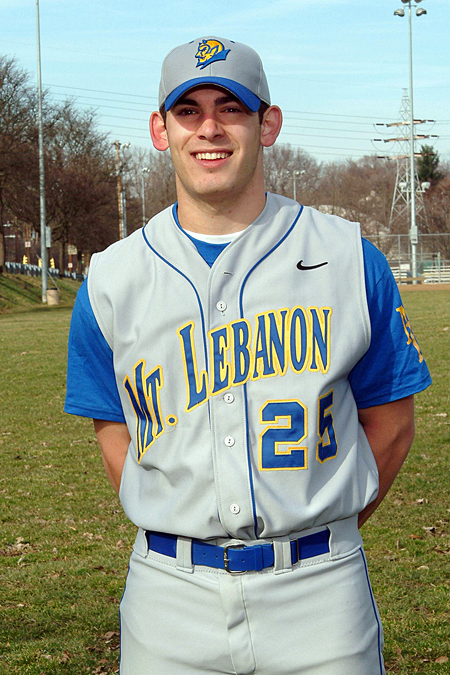
In 2014, Clint Seymour, Mt. Lebanon native, died after receiving head injuries in a street altercation in Charleston, South Carolina. The man who was convicted of assaulting him, Ellis Dalton Clarke, received a prison sentence.
Seymour, 27, had a lifelong love of baseball. All-state with the 2004 Blue Devils, he went on to play college ball at Eastern Kentucky.
In his memory Seymour’s parents, Don and Mary, established the Clint Seymour Play Ball Fund, dedicated to promoting youth baseball and instilling kids with the joy of the game. One of the group’s board of directors is former Pirate and current New York Met infielder Neil Walker, one of Clint’s closest friends.
In 2016, the Mt. Lebanon Commission voted to rename Wildcat Field on Cedar Boulevard, which serves as the Blue Devils’ home diamond, after Seymour. The Play Ball Fund will pay for more than $60,000 worth of improvements to the field, including a new electronic scoreboard, repairs to the bullpen and replacement of safety screens.
In 2015, the foundation donated a new entry sign for Foster School, where Clint, his sister, Carly, and his father all attended. The sign bears a plaque in Clint’s memory.
Although the foundation has made several local donations in Clint’s native Mt. Lebanon, it has a strong focus on building fields and promoting baseball in places where children might not otherwise have easy access to fields and programs. To donate or learn more about the Clint Play Ball Fund, visit www.clintplayball.com.
The Tennis Center (now the Racket Center) in 1965 was named for Martin L. Tressel, a Jefferson Drive tennis devotee and community volunteer who widely promoted the game and helped promote the tennis center with his “time, thought, energy and personal resources.” Known as “Mr. Tennis,” Tressel was vice president of Alcoa International and manager of Alcoa’s Metal Planning Division. He was president of the United States Lawn Tennis Association, chairman of the United States Lawn Tennis Association’s Junior Division Committee and former president of both the Western Pennsylvania Tennis Association and the Youth Tennis of Pittsburgh Foundation. He was also a member of the Alcoa Choir and the Mendelssohn Choir. He spent his retirement developing junior tennis programs across the country. He died June 15, 1972,
Check out what’s
2026 Budget information