Check out what’s
Trending

Sensory-Friendly Open House
This is Home.


If you aren’t sure where to look for specific information on our website, please search here using keywords to learn anything from what day trash pick-up is, how to license your pet or plan a block party to how to volunteer in the community or start a business here.
The Inspection Office oversees enforcement of the ordinance adopted by the municipality to prevent overloading of sanitary sewers. The connection of storm water to a sanitary sewer is not permitted. Regulations controlling this matter are issued by The Department of Environmental Protection, The Allegheny County Health Department (County Plumbing Code) and Mt. Lebanon, as part of the Mt. Lebanon Code Ordinances.
Maintain the quality of life and prevent the loss of public and private property.
The Mt. Lebanon Department of Public Works provides and oversees the delivery of proactive preventative maintenance services to protect public health and safeguard public and private property along 160 miles of sanitary sewer pipes.
Where does the wastewater in your home go? Click for an interactive map and other background.
Before you call a plumber, call 911 and have public works inspect it to see if the clog is in the municipal line before you go to the expense of hiring a plumber. Private plumbers cannot work on municipal sewer lines, only lines that are on your property, so it’s worth it to see where the clog is first.
The municipality performs herbicide root treatment on sanitary sewers on a yearly basis as part of its operation and maintenance program and has been performing this work for over 20 years. Root treatment is a trenchless preventive maintenance technique that kills roots within the sewer system without harming the trees above resulting in minimized disruptions to the municipality’s residents by reducing sewer backups and excavation repairs to correct sewer backups.
Specifications are prepared each year which require contractors to follow required safety protocol and OSHA standards to protect their employees and the public.
The practices utilized in the municipality are in accordance with industry standards for this type of work and this process is utilized throughout the country.
Duke’s utilizes Razorooter®, a herbicide foam that has a consistency of heavy shaving cream. Since effectively killing roots in sewer systems requires access to the entire line, Duke’s crew inserts a hose from manhole to manhole. The hose sprays the foam in all directions, allowing it to adhere to roots and penetrate through wye connections to kill roots even in lateral service lines to your home or other property. The entire system is treated as the foam compresses against pipe surfaces and penetrates cracks, joints and connecting sewers. Roots are killed on contact inside and outside the pipe walls, decay naturally and slough away, with regrowth delayed for two to three years. Trees and other above ground vegetation are not harmed.
The contractor is required to maintain safe vehicular traffic flow while performing the work with minimum inconvenience to the public. The contractor is required to provide residents within 500 feet of any line being treated with a minimum notification of 72 hours prior to beginning their work.
During root treatment operations, there are no interruptions to water or sanitary sewer services.
A certified pesticide applicator from Duke’s Root Control and a Mt. Lebanon Public Works inspector are on the site at all times. The foam or herbicide used never comes in contact with anything other than the inside of the sanitary sewer system.
Duke’s Root Control Inc. will perform sanitary sewer root control work on the municipal sewers as indicated on the map.
For additional information or questions regarding the Mt. Lebanon herbicide root treatment program, call Bob Hunn, Jr. at (800) 447-6687.
In order to control overloading the sanitary sewer, the Pennsylvania Department of Environmental Protection requires each local government to adopt a corrective action plan. One of the requirements of the plan is to reduce overloads to the sanitary sewer by removing rain, or storm water, from the lines. The purpose of dye testing is that property owners can correct the situation and bring their property into compliance. The Public Works Department will provide counseling to the property owner in the most efficient way to correct the problem.
Each year, Mt. Lebanon has a percentage of its sewers inspected. From time to time, those inspections reveal some lines that need to be repaired. One of the repair options uses a procedure called lining, to avoid having to dig a trench at the site of the line. It involves cleaning the line, temporarily re-routing the drainage and inserting a liquid resin which is then heated to create a new smooth inner surface. The line is then inspected again and the flow is restored. It is generally quicker and cheaper than digging and replacing the sewer line. The procedure is usually used on sanitary sewers (sewers that carry household waste water) but can be used on storm sewers (sewers that carry rain runoff.) Lining our aging sewer system significantly reduces the number of blockages and backups.
If the sewers near your home need to be lined, you will be notified by flyer.
See a map of current sanitary and storm sewer lining work.
Keep reading for more details.
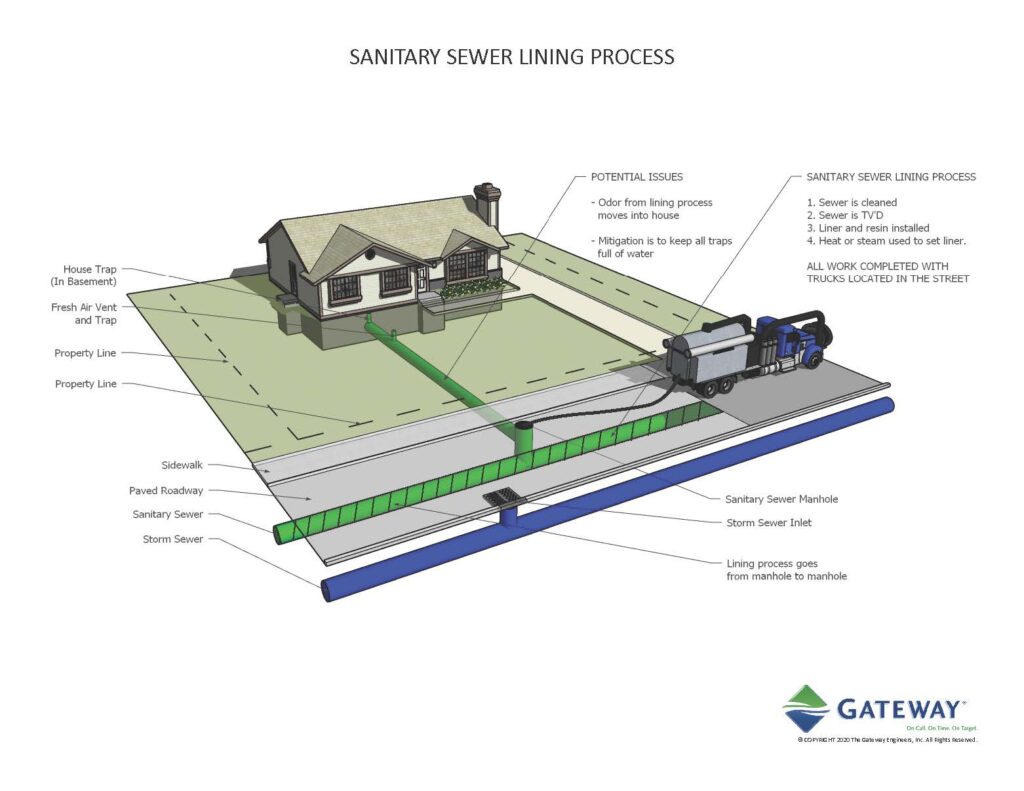
The municipality performs Cured in Place (CIPP) lining of storm and sanitary sewers each year. The municipality has been rehabilitating sewers with this trenchless technology for more than 20 years and it is used all over the world. CIPP lining creates a new structurally sound pipe within the existing pipe and extends the life of the sewers approximately 50 years while minimizing disruptions to the municipality’s residents by eliminating the need for excavations.
We prepare specifications year that require contractors to follow safety protocol and federal Occupational Safety and Health Administration (OSHA) standards to protect their employees and the public.
The practices used in Mt. Lebanon are in accordance with industry standards and best practices for this type of work.
Pre-CCTV and cleaning are required prior to lining to inspect and prepare the pipe for lining. The contractor is on site for this and must access manholes to be able to perform the work.
The contractor returns later to execute lining work once they confirm the condition of the pipe and prepare materials. The contractor is required to notify all residents within 250 feet of the work at least 72 hours prior to beginning their work.
During lining operations, water service is not interrupted. However, during liner installation, the sewer service lateral connection to affected properties is closed off at the main sewer line. After completion of the liner installation, all active lateral connections are reinstated.
In order to avoid a backup during the lining installation, residents must only use water for emergencies. All sump pumps must be turned off as well.
We require a certified National Association of Sewer Service Companies (NASSCO) contractor to televise the sewer after liner installation to confirm successful completion of the lining work. This is typically completed during the lining process, but it may happen the next day due to schedule constraints.
While performing the lining, the contractor uses steam to trigger the reaction for the lining resin to cure. The steam passes through the pipe and is discharged into the atmosphere. NASSCO studies on this process have established safe practice techniques contractors are to follow.
Occasionally, residents may experience a resin-like odor in the home. The odor originates from a material called styrene, which has a very low odor threshold, meaning you can smell very low concentrations of the material. The styrene is part of the resin that cures the liners and can also be found in building materials, automobile exhaust and photocopy machines.
If residents experience odor inside the home, this indicates the home has deficient fixture traps and/or house traps. Filling basement traps with water may help to prevent this odor from entering the home. Should resin odor enter the home, the house should be ventilated by opening windows and running fans. Residents smelling the odor should consult a registered plumber to inspect and repair deficient home plumbing, to bring so all house traps and plumbing fixture traps into compliance with the International Building Code.
Check out what’s
Sensory-Friendly Open House